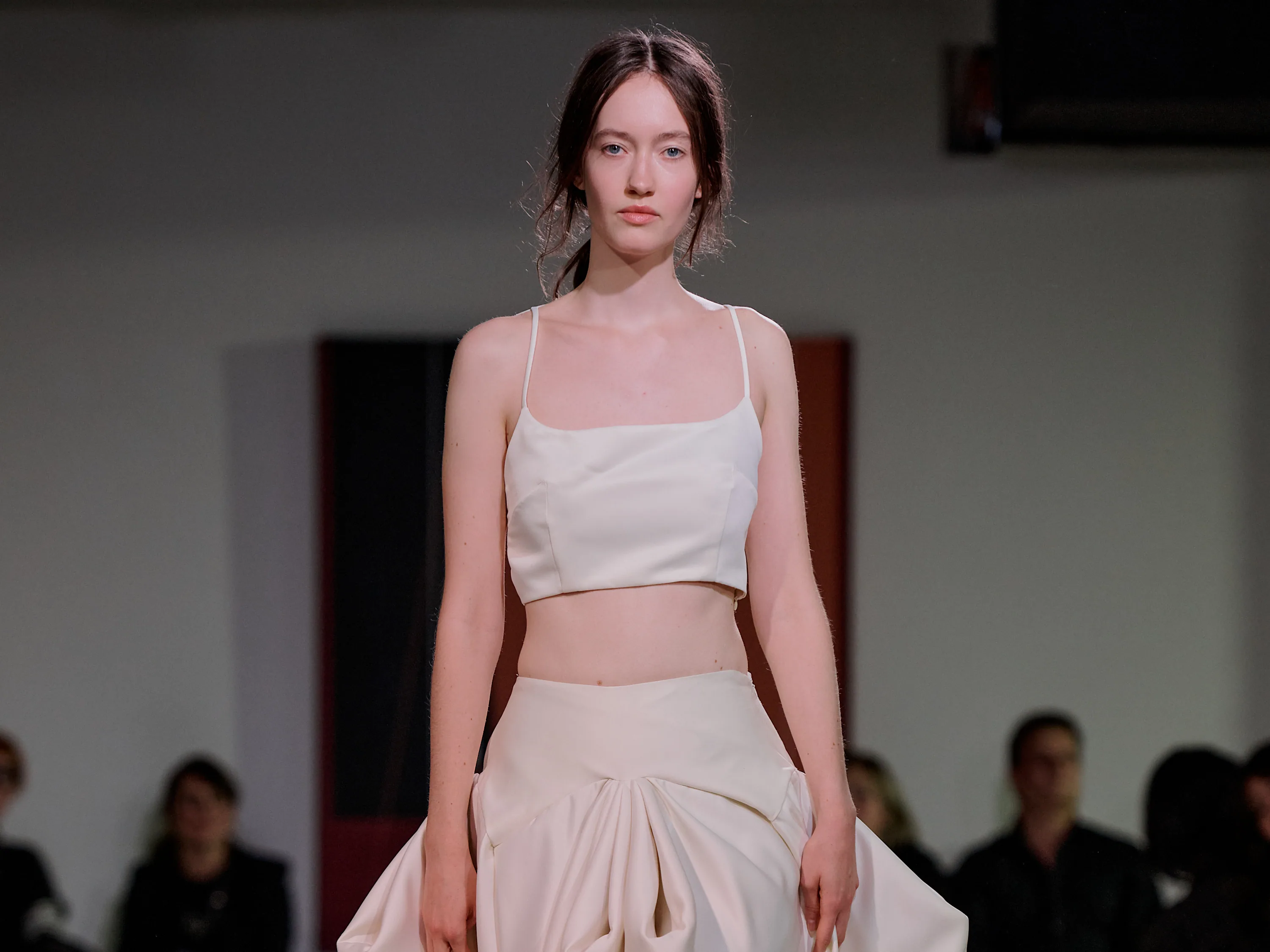
Electronic music pulsed above the runway, while an entire creative ecosystem worked behind the models. Budapest Metropolitan University reported on 2 November that its 28 October Graduate Fashion Show placed nearly one hundred individual looks on the Apollo Gallery runway across two sold-out presentations. The number is striking, but the more important story is how graduate collections became a shared professional production.
Personal stories remained central
The show was titled “The Synergy of Collaboration”. Graduates from the Fashion and Textile specialisations of the Textile Design BA programme and the Fashion and Textile Design MA programme drew on cultural heritage, family memories, the search for identity and social expectations. The university highlighted material experiments, reuse and contemporary applications of traditional craft. These collections cannot be reduced to one trend label. The sources indicate that each designer brought a distinct question to the runway.
The distance between a diploma collection and a functioning show is considerable. Garments must remain legible in motion, styling has to connect different worlds and backstage changes must run to the minute. METU students and alumni worked on styling, photography, guest reception and production. That experience resembles a real fashion-house workflow more closely than a conventional degree exhibition.
For an emerging designer, the runway is not an ending. It tests whether an idea can also work through a team.
Several disciplines met in one evening
Students from the University of Pécs created the electronic soundtrack, KREA Design School students produced the make-up, and the KEVIN.MURPHY team handled hair. These are not incidental credits. A runway image is built from the decisions of many professions, and a young designer must learn to communicate a concept clearly enough for make-up artists, hair stylists, fashion stylists and musicians to reinforce the same story.
PRAE.HU’s preview had already noted that collaboration would operate as both subject and working method. The university’s 2 November report suggests that the promise was delivered: the public presentation and the professional evening show both reached capacity. A full room is an opportunity rather than proof of quality. The next test is which graduate collections can continue through portfolios, competitions, production or independent labels.
What the industry should watch next
Hungarian fashion frequently speaks about a new generation, yet genuine talent development cannot be measured through lists of names. It becomes visible when a designer can present a precise product, a coherent image and a feasible production plan. The METU show tested the first two in public. Portfolios, collaborations and first orders over the coming months will reveal more about the third.
The Graduate Fashion Show has offered a platform to METU graduates since 2017. This edition’s strength was its refusal to place authorship and teamwork in opposition. Every garment carried a separate story, while the production showed that independence becomes professional value when it can be realised accurately with other people.