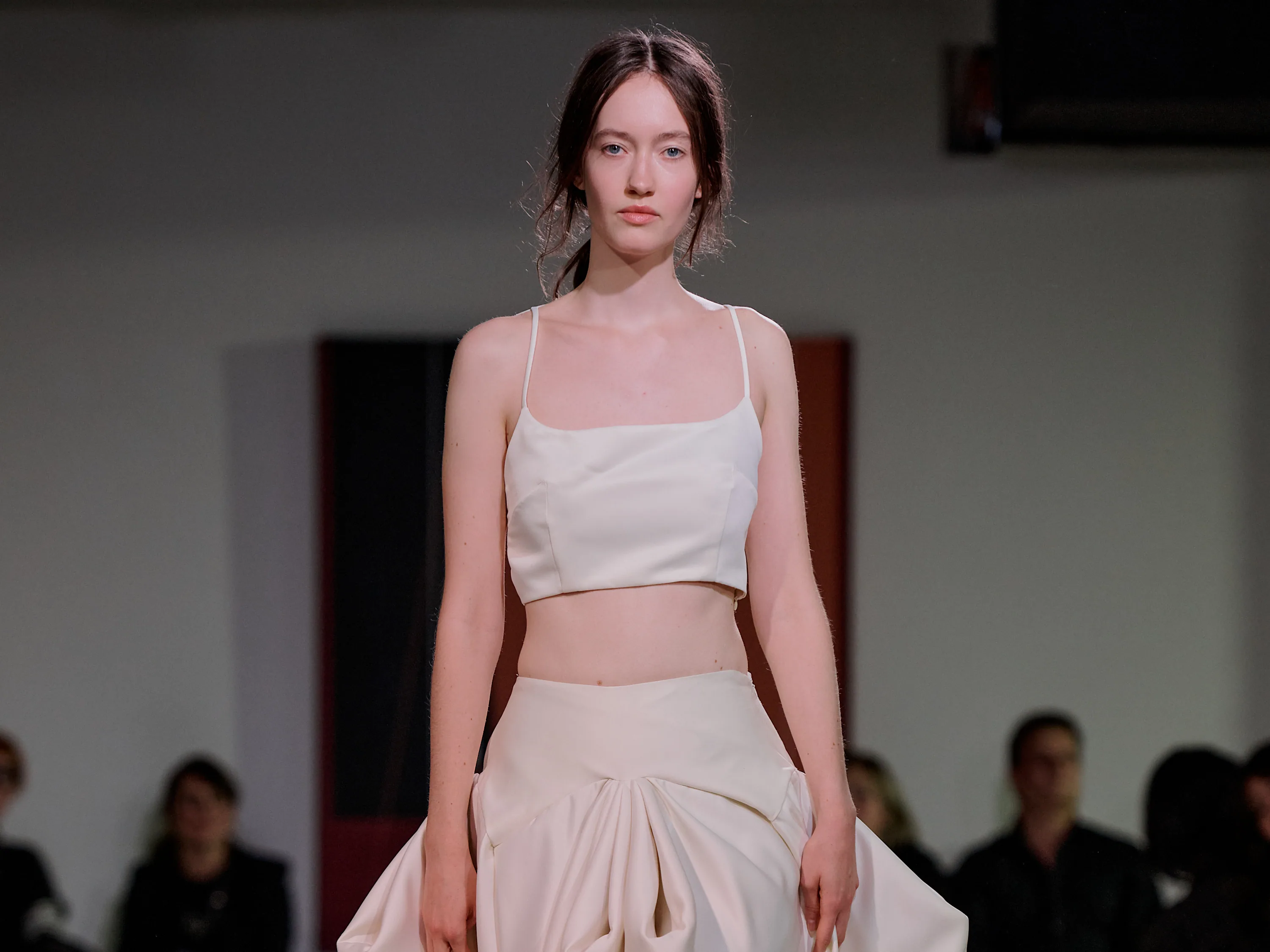
On 18 November at 6 pm, Barabás Villa in Budapest will connect contemporary painting and fashion design in an event titled Eseményhorizont, Nincs visszaút. Painter Krisztina Major and designer Zsófi Kovács, working as SEMA, will present the project, opened by Gábor Szakács. Its value is not a simple transfer of an image onto fabric, but the question of how a motif changes when it moves on a body.
The title marks a point of decision
The official venue page describes Nincs visszaút, or No Way Back, as the creative point after which a work follows its own rules. In Major's painting this may be a gesture, layer or colour relation. In clothing the equivalent decision can be a seam, the direction of a material or the placement of a surface.
Major's official biography and an earlier project page confirm that her painting and SEMA clothing have collaborated before. This matters. The evening is not an arbitrary brand pairing but a new stage in an established visual exchange.
More than a carrier surface
A painting usually offers a fixed viewpoint. Clothing is seen from the side, back and in motion. Fabric folds, changes with light and can be interrupted by seams. The designer's task is therefore translation, not exact copying. She must decide which detail can survive a fold, where to leave space and how the silhouette can retain the strength of the motif.
At the show, watch whether a painted gesture follows the body or deliberately resists it. A motif that only becomes legible at close distance may also be effective. A strong collaboration does not reduce one artist to illustrating the other. Both media must make their own decisions.
Practical details and stakes
The venue is Barabás Villa at Városmajor utca 44 in Budapest's twelfth district. The official start is 6 pm on 18 November. The independent Blipest listing gives the same core details, though visitors should check the organiser's page before leaving.
Budapest fashion needs small formats in which clothing is more than product and painting is more than background. The scale of a villa brings the audience closer to material and detail while creating a professional meeting point.
Documentation is part of quality. Captions should separate painter, designer, model and photographer, while back views and detail images should remain available after the show. That allows the project to become a professional record rather than disappear as one evening's impression.
The success of Eseményhorizont will depend on whether a shared idea is visible in the garments. If the title is the only connection, the partnership will remain superficial. If image and cut genuinely rewrite each other, the evening can establish a new working method.