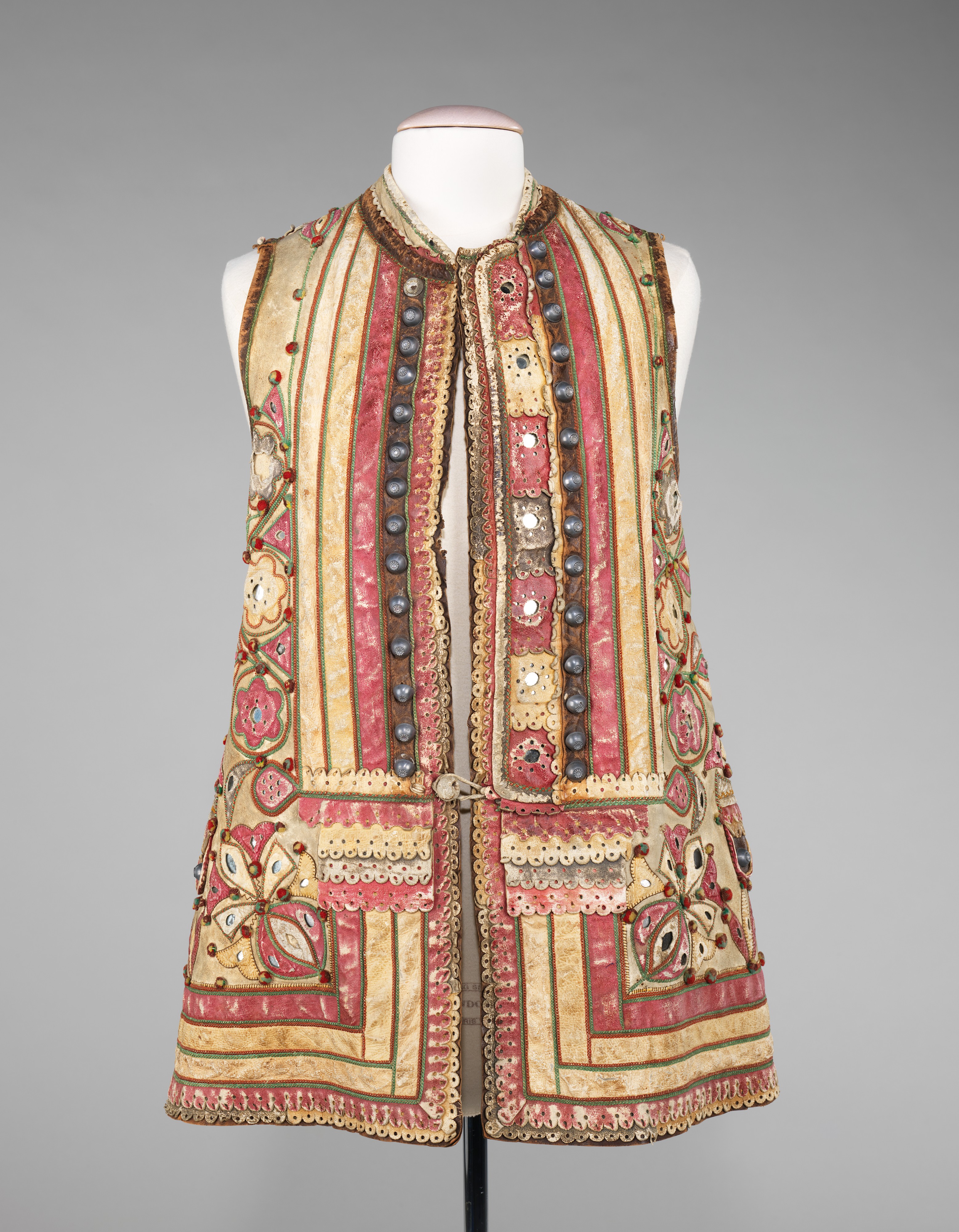
Red bands, small reflective inserts and dark rounded ornaments on pale leather guide the eye as though the garment had its own lighting. On a piece dated by the Metropolitan Museum to 1840–70 and documented with a Transylvanian connection, reflection matters as much as colour. These small differences between materials offer a way to reread Hungarian dress heritage.
Light works beside colour
The Met holds object 2009.300.53 under the title Jacket, although its descriptive text discusses it as a vest-like garment. The materials listed are leather, mica and metal. Classified as children's outerwear, it measures 77.5 centimetres along the centre back. That classification deserves attention: display on a mannequin does not itself establish an adult male or female wearer, and its sleeveless appearance cannot supply every historical garment name.
In the photograph, repeated vertical bands run along both sides of the front. Narrow greenish lines sit beside broader red and pale areas; farther inward, dark round ornaments give rhythm to the opening. The surface does not operate as one continuous field of embroidery. Edges, bands, small bright points and plant forms alternate, leading the eye along the centre line and then sideways towards individual motifs.
This arrangement reads differently near and far. From a distance, vertical divisions hold the figure together; close up, differences between materials take the lead. Matt leather beside reflective elements also suggests the possibility of movement: not every detail catches light from the same viewpoint. This is visual analysis, not an experiment involving the garment being worn today.
According to the museum's explanation, the original colours could have produced a stronger effect than their faded present state, particularly alongside reflective surfaces. It also mentions the traditional use of mirrors to ward off harmful forces. This is a cultural interpretation, not a surviving personal statement by the original owner. It cannot establish that particular wearer's intentions with certainty.
Ornament is shaped not only by its motif, but by the way it receives light.
Leather clothing has more than one cut
Magyar néprajz, published under the names of Iván Balassa and Gyula Ortutay, approaches outerwear differently, distinguishing garments of woollen cloth from those made of leather. Its simplest description of a melles identifies front and back pieces joined by ribbons at the sides; it also discusses Székely and Csángó versions with one sewn side, a buttoned closure on the other and a richly decorated front. These are general types, not missing patterns for the Met garment.
The distinction remains useful for designers. Cutting determines which surfaces meet and how the garment goes onto the body; decoration subdivides those surfaces. A vertical band may emphasise an opening without proving that a seam lies underneath. A dark rounded element may serve as a striking point of rhythm without our having to identify it as a functioning button from a photograph.
Another Met object, Hungarian men's vest 2009.300.61, dates to the last quarter of the nineteenth century. Its materials are leather, wool and cotton, with a centre-back length of 49.5 centimetres. This is a separate piece, not another view of the same garment. The differing records demonstrate why ornate leather tops should not all be forced into one ready-made category.
What can a detail carry forward?
The Transylvanian connection involves historical geography too. The Met discusses the garment's period within the Kingdom of Hungary while noting that Transylvania is now part of Romania. The collection's Hungarian designation should therefore be read as documentation of this object; on its own it does not identify the ethnic self-understanding of its maker or wearer.
The garment reached the Met in 2009 through the transfer of the Brooklyn Museum costume collection. Its earlier collection history connects it to museum expeditions in 1920 and 1921 and the Robert B. Woodward Memorial Fund. Making, collecting and the present museum transfer form three distinct layers of time. An archive object photograph does not collapse them into one event.
Our article on the suba approached leather through a different cut and scale. Here, the design lesson brings the eye closer: a few bright points beside a matt surface can organise a composition. A future Hungarian collection need not quote the whole historic garment; the more interesting question may be how light can acquire a new role.