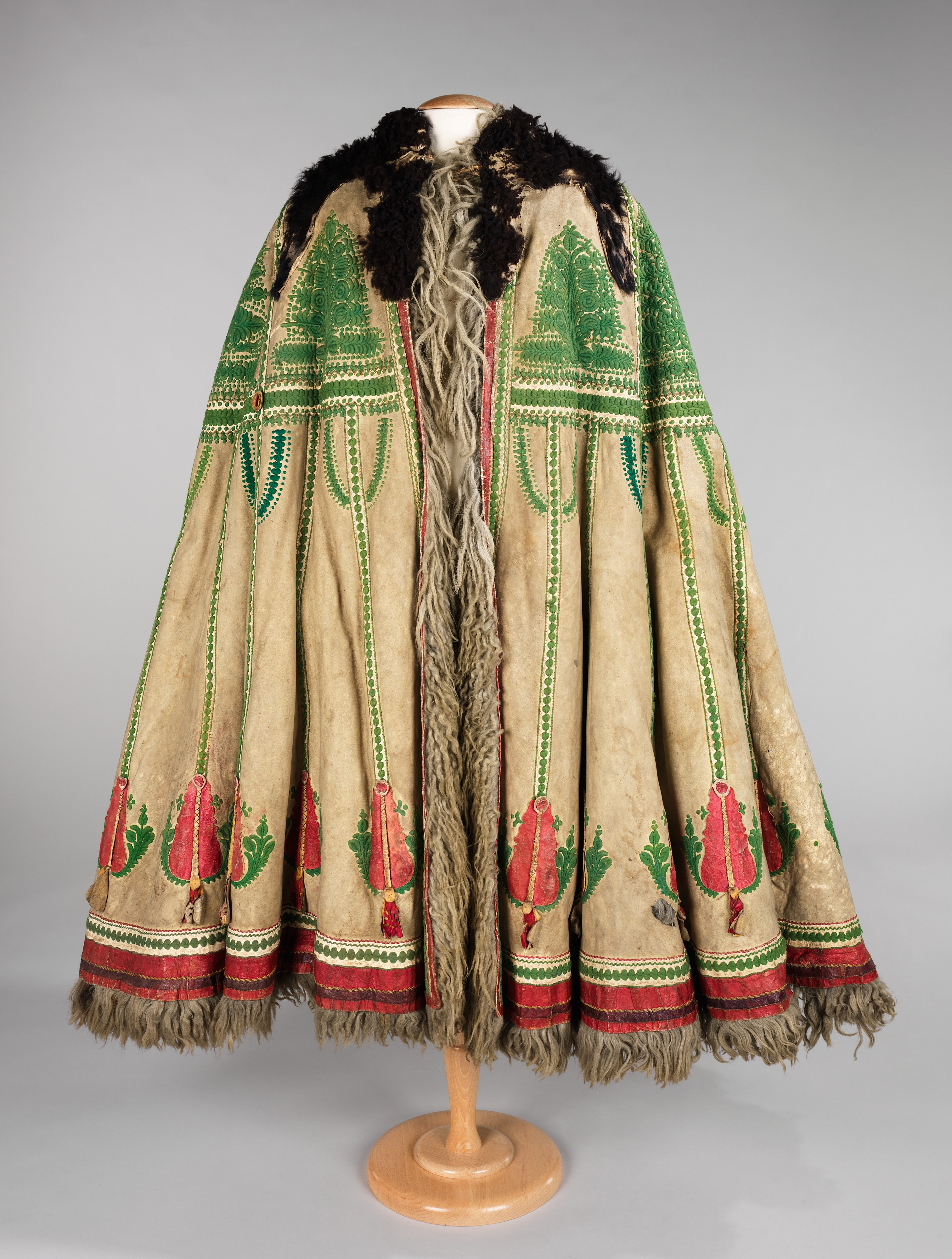
Green tendrils descend across pale leather, while red flowers repeat above the lower edge. Black lambskin rests across the shoulders; the open front reveals long wool. The Hungarian suba in New York’s Metropolitan Museum resembles a ceremonial mantle from a distance. Up close, it is a garment whose decoration and use belong together.
Dated between 1840 and 1870, it is made of leather and wool, with a recorded centre-back length of 127 centimetres. Its accession number is 2009.300.49. It entered the Met from the Brooklyn Museum costume collection in 2009; earlier acquisition information refers to museum expeditions in 1920 and 1921. Manufacture, collection and present ownership are three separate historical facts.
The shoulders organise the image
In the photograph, the dark collar frames the neck. Below it, the widening body almost encloses the wearer, while vertical patterned bands lead the eye downward. A red border gathers the bottom into a unified edge. This composition can be observed in the object photograph; it does not establish how a particular former owner moved in it.
The different emphasis at shoulder and hem nevertheless reveals a clear design problem. How can a large surface be divided without becoming shapeless? Here, a single enormous central motif is not the answer. Repeated smaller elements, vertical bands and framing edges establish the rhythm together.
The Met identifies foliate embroidery and leather appliqués. These techniques build surfaces differently: embroidery draws with thread, while appliqué places another material layer onto the base. Reading the photographed design therefore involves more than naming flowers. It also means noticing changes in thickness and moments when an edge becomes prominent.
Clothing that creates an environment
The museum describes the suba as traditional Hungarian shepherds’ clothing, mentioning its use as a seat or bed alongside protection from the weather. Júlia Bartha’s ethnographic work on the Kunság independently discusses the relationship between sheepskin clothing and pastoral life. Their shared point is not a fashionable adjective but a connection between material and everyday surroundings.
That does not justify rating this object as a modern technical coat. This article has not measured waterproofing, insulation or comfort. Historical use is interesting precisely because it reveals different expectations: outerwear could perform tasks beyond the boundaries of the body.
The suba’s decorated surface does not conceal function; it makes the material’s weight and significance visible.
This offers a useful perspective on contemporary construction. A coat’s shoulder line, opening and hem jointly determine our perception of the space around the body. The suba makes these components unusually easy to distinguish. Visible wool inside and decorated leather outside are two sides of the same material system.
One object is not an entire costume tradition
The Museum of Ethnography’s description of its 2002 exhibition “Félre gatya, pendely” drew attention to the ways clothing shapes the figure, mentioning the suba among men’s outer garments. This independent institutional interpretation helps move beyond treating traditional dress solely as a catalogue of motifs.
Hungarian readers may be particularly tempted to see every floral surface as one unified national style. Yet a single object cannot automatically represent every region, occasion or social group. The Met’s documented information and the photograph’s observable details provide firmer starting points than an atmospheric claim extended across a whole culture.
For contemporary designers, copying the ornament unchanged is not the most interesting lesson either. The principles of division, emphasis at the shoulders and deliberate exposure of the inner material can each be studied separately. A new garment does not thereby become a suba or automatically inherit its historical meanings.
The front opening also shapes the photograph’s legibility. If both sides met completely, little inner wool would be visible and pale leather would dominate the image. This display lets us perceive external decoration and internal material together. It is a museum presentation decision, not evidence that one historical way of wearing the garment was exclusive.
Next time you encounter a coat with a large surface, look at construction before pattern: what supports the form, what opens it, and what brings it to a close? On this suba, the black shoulder section, vertical drawing and red border answer together. The motif comes afterwards.
Related reading: More from the magazine.