Judith Leiber’s bags are easily recognised by an animal outline or the dense sparkle of crystals. The new volume Brilliant by Design also brings readers closer to the creative and commercial decisions behind the objects. Yale University Press published the American edition on October 27; Town & Country published a conversation with its author, Bridget Kerr, on October 29. One substantial thread in that interview concerns how period magazine advertisements can serve as sources for design history.
According to the publisher, the book, subtitled The Handbags of Judith Leiber, runs to 208 pages with 140 colour illustrations. It presents more than a hundred handbags and accessories alongside previously unpublished archival photographs. Kerr’s biographical work is complemented by contributions from Annie Carlano and Hilary Davidson, with an afterword by designer Olympia Le-Tan. Yale’s British website gives November 10 as its publication date, so the two markets’ dates should not be conflated.
The Hungarian connection lies at the foundation of the career: Leiber was born Judith Pető in Budapest in 1921 and learned her craft in Hungary’s handbag industry. She later established her own business in New York in 1963. That professional grounding encourages a different reading of the spectacular evening pieces. For a rigid-sided minaudière, opening, closure and interior proportions are design problems as much as external shape.
In Town & Country’s original interview, Kerr discusses the magazine’s old advertisements as particularly valuable research material. They reveal more than which bag entered public view at a particular moment. They also show the setting in which it appeared and the kind of customer it was presented to. Kerr connects this to Leiber’s business acumen. Identifying the right audience belongs to the story alongside the sparkle.
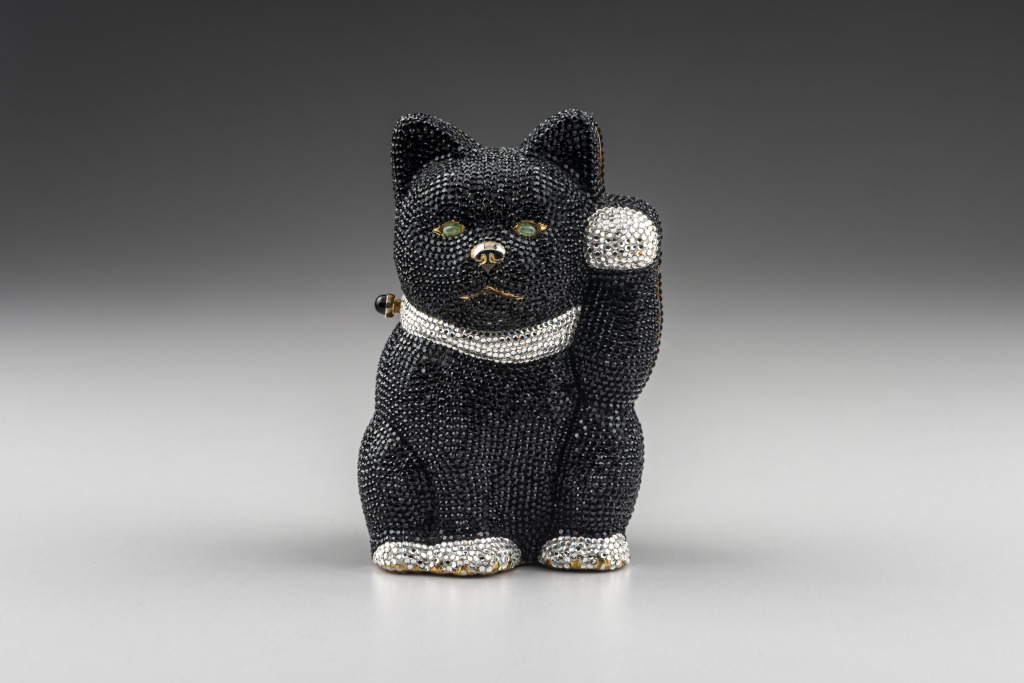
Object records from the accompanying Mint Museum exhibition provide a useful counterpoint to a generalised brand image. The black cat bag with a raised paw, dating to around 1994, combines gold-plated brass, leather, Swarovski crystals and semiprecious cabochon stones. Its form is playful, while the materials imply a layered construction. In our editorial reading, the object is interesting precisely because it must reconcile the appearance of jewellery with the functions of a container.
The museum’s material also distinguishes the designer’s personal work from the brand’s subsequent history. A pink telephone bag dating to around 2013 is attributed to Judith Leiber, Inc. That date cannot automatically be assigned to the designer’s own hand or active creative period. Precise authorship matters as much as an eye-catching object name.
For readers in Hungary, the book’s most interesting promise is that it offers ways to examine documented design achievement beyond celebrating Hungarian origins. You do not have to collect the bags to find professional questions in a clasp, a metal frame or an advertisement’s composition. The next step is to read the archival object together with its image: how did a small handbag become a recognisable cultural sign?
Related: Judith Leiber’s Budapest craft foundations.