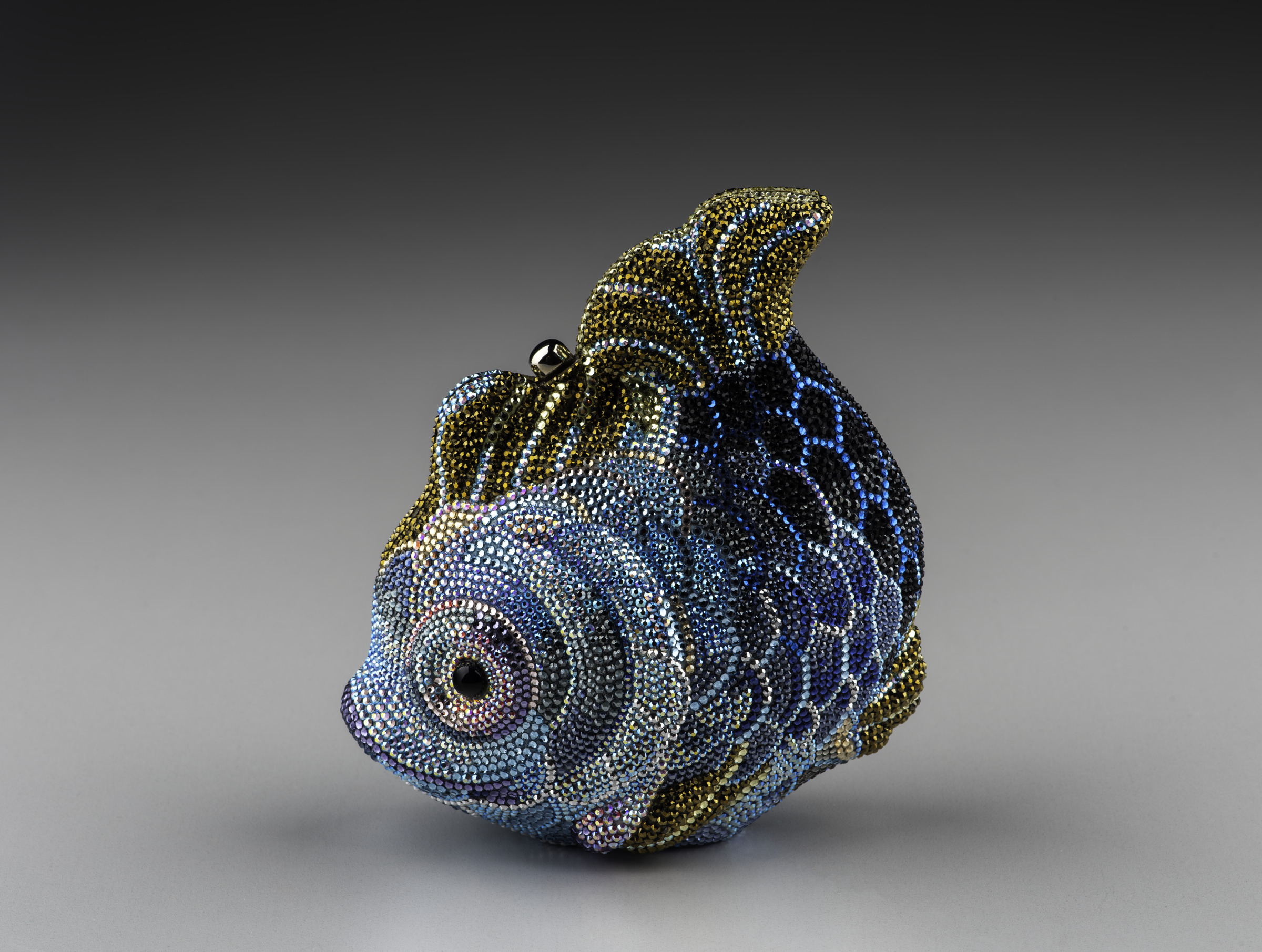
The fish’s scales catch the light in blue and gold, but the real surprise is that the object opens. This is an evening bag, not a small sculpture made only for a display case. The 2007 example in The Mint Museum’s collection belongs to a later chapter of the Judith Leiber brand. Yet it captures the idea its namesake made recognisable: a bag can be a useful object, a jewel and a character in its own right.
Opening on October 24, Brilliant by Design at the Charlotte museum will bring together more than a hundred bags and accessories. Running until July 3, 2027, the exhibition offers more than a spectacle of crystals. For us, it is also an opportunity to consider how a craft learned in Budapest became an internationally recognisable design language.
The hand learned before the brand existed
Research by the Museum of Arts and Design identifies Leiber’s Budapest apprenticeship as a formative stage. She trained in the Pessl workshop and played a pioneering role as a woman in the professional guild. That background matters because a handbag is never just a surface. Its exterior, lining, closure and grip are inseparable design problems.
In a 2001 Smithsonian profile, Leiber described learning to make a complete bag in Hungary. She later encountered a different division of labour in American manufacturing. There is no reason to turn that distinction into a ranking of nations. The useful professional lesson is that someone who understands the whole object approaches detail differently from someone responsible for a single operation.
That knowledge is particularly valuable in a spectacular evening accessory. An unusual shape must still function in the hand. An opening can interrupt a pattern; a misplaced structural element can spoil the proportions. Decoration does not automatically conceal construction. At its best, precise construction makes decorative freedom possible.
When a bag becomes a character
Leiber established her own brand in 1963. The museum’s account gives importance both to leather bags and to the rigid evening cases that followed. A minaudière is a small, hard-sided occasion bag. To understand it, it helps to set aside the everyday handbag question of how much will fit inside.
The visual task is different here. A small object can create an exceptionally strong focal point within an outfit. An animal shape, saturated colour or densely sparkling surface can reorganise the emphasis of everything around it. Our editorial reading is that this sense of proportion is one of the strengths of Leiber’s legacy: the scale is modest, the presence anything but.
For the fish bag in our opening image, the museum’s object description lists silver-plated brass, Swarovski crystals and leather. These materials do different jobs. Metal holds the form, crystals organise the light across its surface, and leather reconnects the object with handbag-making tradition. The 2007 date must be kept separate from Leiber’s own creative career: we do not automatically attribute this later branded object to her personal design work.
Sparkle asks for attention; construction gives the memory staying power.
What can a Hungarian designer take forward?
The Budapest connection is more than a birthplace. This story reveals the value of workshop knowledge in a market where a first encounter often consists of an image on a screen. A photograph persuades through outline and colour; close up, workmanship must deliver. The two experiences reinforce each other when they express the same design decision.
The exhibition is an opportunity to explore that relationship, but travel is not the only route. Yale University Press lists the accompanying book for US publication on October 27. Its 208 pages and 140 colour illustrations could provide a practical starting point for research in Hungarian workshops and fashion classrooms. These are the publisher’s specifications; we are not claiming to have read a book that has yet to appear.
For contemporary small-batch design, this can be a particularly precise test. Examine an object open and closed, in the hand and resting on a table. If its form remains coherent in each position, genuine thinking about the object supports its appearance.
The next interesting question is therefore not whether crystals will return. It is which designer today can create an individual form whose every detail answers the hand and the eye with equal precision.
Series: In the Workshop. Edited by Fashion Week Review. Updated September 30, 2026.
Exhibition and visitor information · Museum research · Smithsonian profile · Forthcoming book
A related Budapest event: Antal Csipes on reading fashion images.