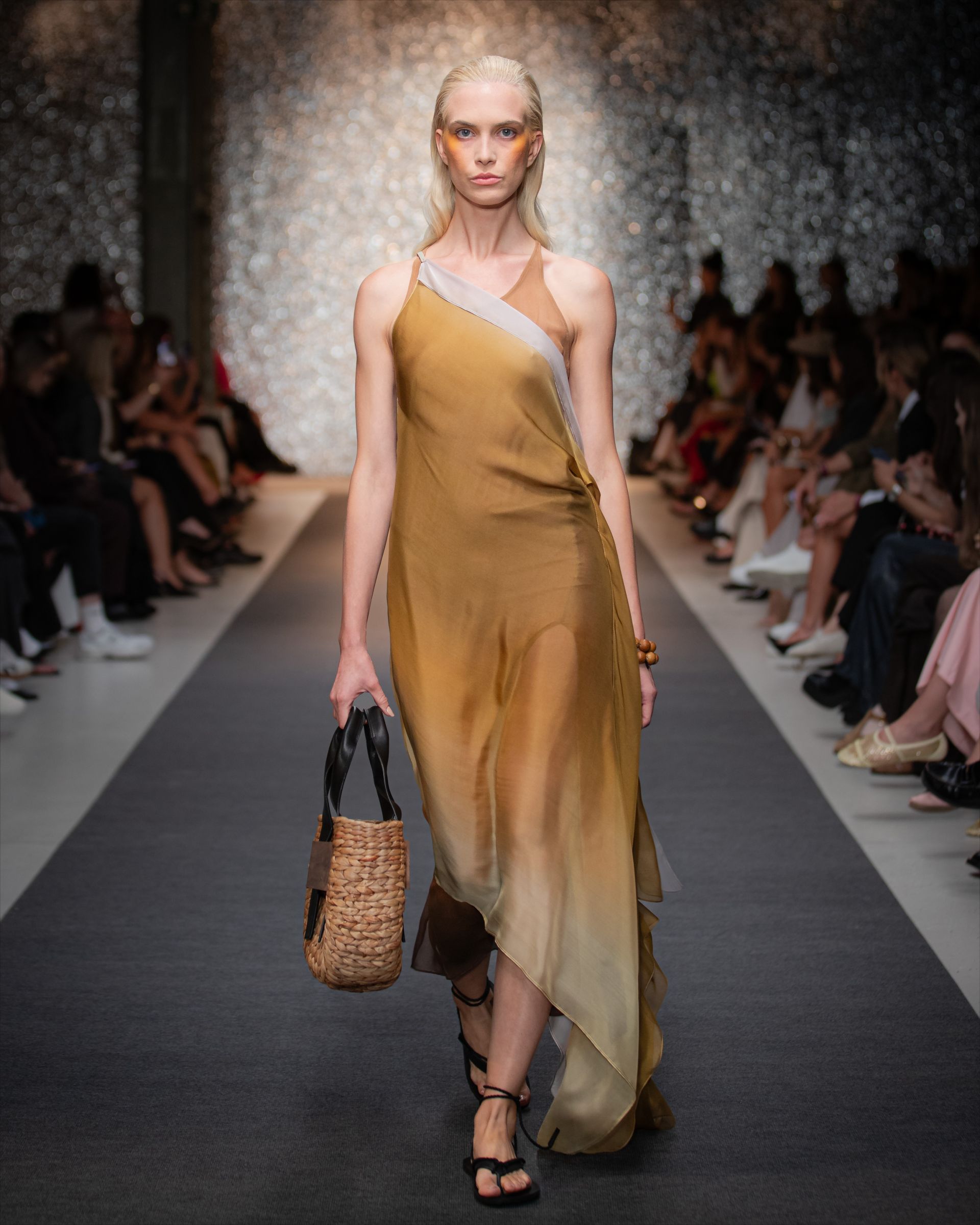
MOME Open launched its Pattern Cutting: Dress course on 6 November in the MOME ONE fashion workshop. Participants do not begin with a finished paper pattern. They place fabric on a dress form and develop the garment’s lines directly on the body’s three dimensional shape.
This makes draping both a design and a construction method. The fall, weight and stretch of the textile become visible at once, while every pin, cut and marking can later be translated into a flat pattern.
From drawing to seam
According to the official programme, the course begins with reading a fashion sketch and continues through shaping, cutting and construction technology. Participants must do more than build an attractive silhouette. They need to consider seam placement, available machinery, fabric behaviour and the way an idea fixed on a dress form becomes a repeatable product.
Sessions take place on 6, 7, 13, 14, 20 and 21 November for a total of 35 lessons. The location is the fashion workshop on the second floor of MOME ONE. A group exhibition at the end will make the completed work visible.
Good draping does not hide structure. It derives structure from the behaviour of the textile.
Why it is more than free shaping
The Fashion Institute of Technology places draping within the wider system of technical apparel design, patternmaking and grading. The Fashion and Textile Museum defines the method as working with fabric directly on a dress stand to develop the three dimensional basis of a garment pattern.
These external sources correct the romantic image of an improvised atelier. Draping is not simply intuitive fabric throwing. It requires clear axes, grain direction, balance, matching points and lines that can later be recorded in two dimensions. Freedom comes from understanding those constraints.
What it offers the Hungarian profession
Training that narrows the gap between concept and construction is particularly valuable in Hungarian fashion education. A collection does not become manufacturable when it looks good in a sketch. It becomes manufacturable when pattern, material and sewing sequence support the same intention.
The November MOME course is therefore workshop knowledge rather than a trend presentation. The group exhibition will show the result, but the real professional achievement lies in the process: turning a flat material into a coherent garment that can be made again.
The method can also give practical advantages to studios working in small series. On a dress form it becomes clear quickly where too much fabric is being consumed, which seam restricts movement and how the silhouette changes with a different fabric weight. Early recognition can reduce the number of unnecessary prototypes, but only when the three dimensional form is documented with precise markings and a checked paper pattern. The value of the course is therefore shown by a repeatable workflow, not by one spectacular dress.