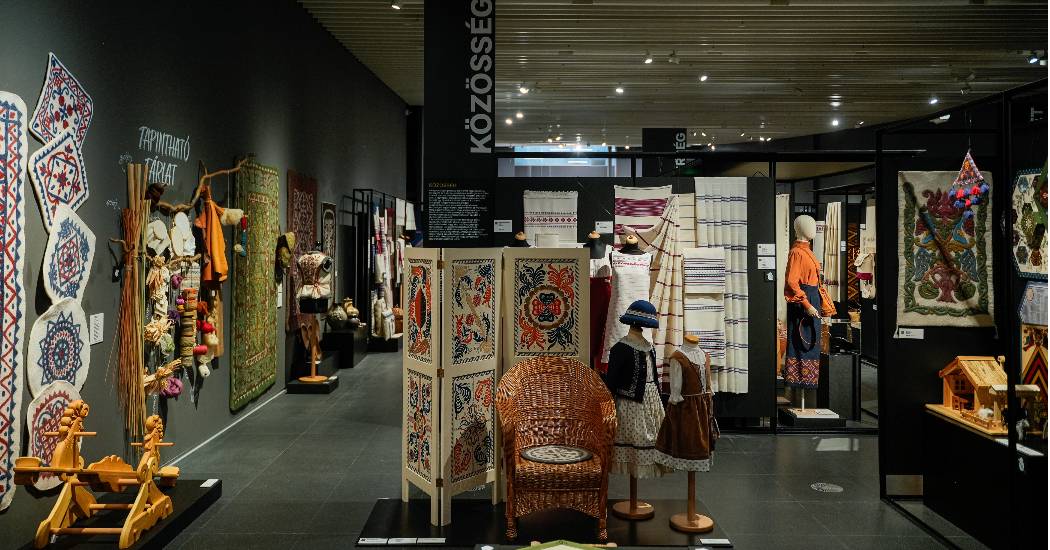
A wicker chair stands in front of a floral screen. Beside it are two dressed mannequins; behind them hangs a row of striped cloths. In Dávid Demeter’s photograph of Budapest’s Museum of Ethnography, the things we wear share a corner with the things we use to furnish a room. On Saturday 28 November at 11 am, folk artist Szidónia Péter, one of the exhibition’s curators, will lead an hour-long tour. Anyone coming for the clothes could happily spend a few minutes in this corner alone.
The 18th National Folk Art Exhibition shows work by contemporary makers. For someone interested in fashion, that distinction matters. In front of an old garment, we might ask who wore it and when the occasion called for it. With a piece made today, we can also ask what its maker kept from what they were taught, and what they changed so that someone would want to wear it now. Behind the mannequins, for instance, you can compare the widths of the stripes without knowing the first thing about weaving. The difference in rhythm registers from across the room; what produces it rewards a closer look.
The selection in Budapest is the result of several rounds. Makers submitted roughly 6,000 works, and eight regional exhibitions preceded the national show. The figure of 6,000 refers to entries. A report from the regional opening in Békéscsaba by behir.hu puts a human face to that number. In June, embroiderer Vera Zuberec from Novi Bečej described the communities she works with: she embroiders in a group of twelve in Novi Sad and leads another circle of twelve in Vojvodina. She used to travel to Békéscsaba to learn. Following just one maker traces the passage of a skill from one town to another.
One pleasure of the Budapest show is that you can find a way through it other than by craft. Its eight themes include play as well as community and celebration. In the second photograph, a textile depicting a hussar hangs behind a high-backed openwork wicker chair, with small figures nearby. Try looking as you would at a clothing collection: follow a recurring shape, then see what another material does with it. The open weave draws the background into the pattern of the chair; on the textile it is the drawn outline that holds the figure together.
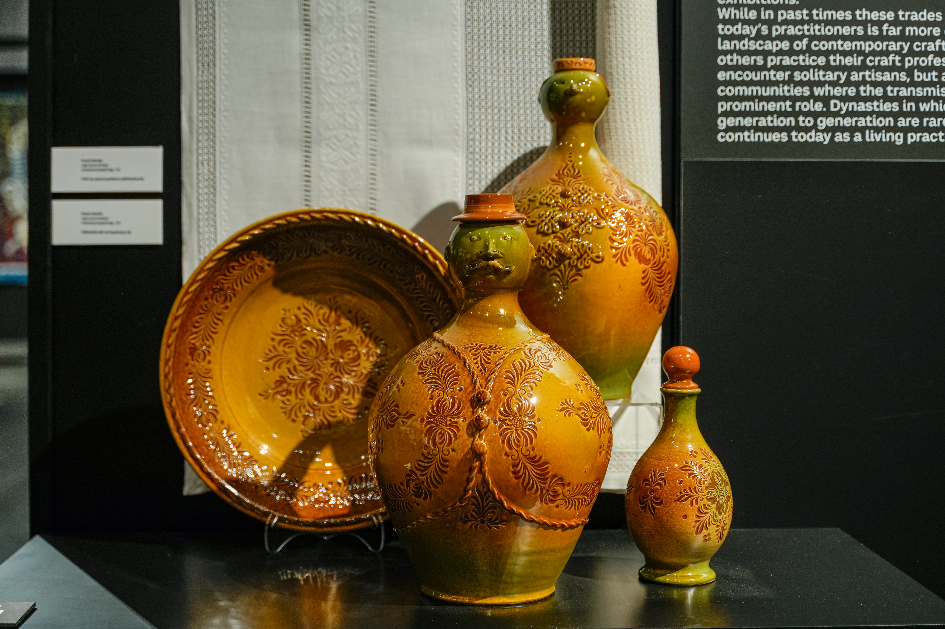
Detail of the Budapest exhibition, autumn 2026. Photograph: Dávid Demeter / Museum of Ethnography.
Saturday’s visit requires two separate tickets: admission to the exhibition and a ticket for the guided tour. Select 28 November on both pages. The meeting point is the central information desk on level minus two, and the tour ends at noon. If you cannot make it that morning, the exhibition, which opened on 29 October, can be visited independently until 11 April 2027. On your way out, take one motif with you in your mind: where would you notice it first, on the sleeve of a coat, along the edge of a scarf or on the wall of a room?
Related reading: The handwork behind Halas lace