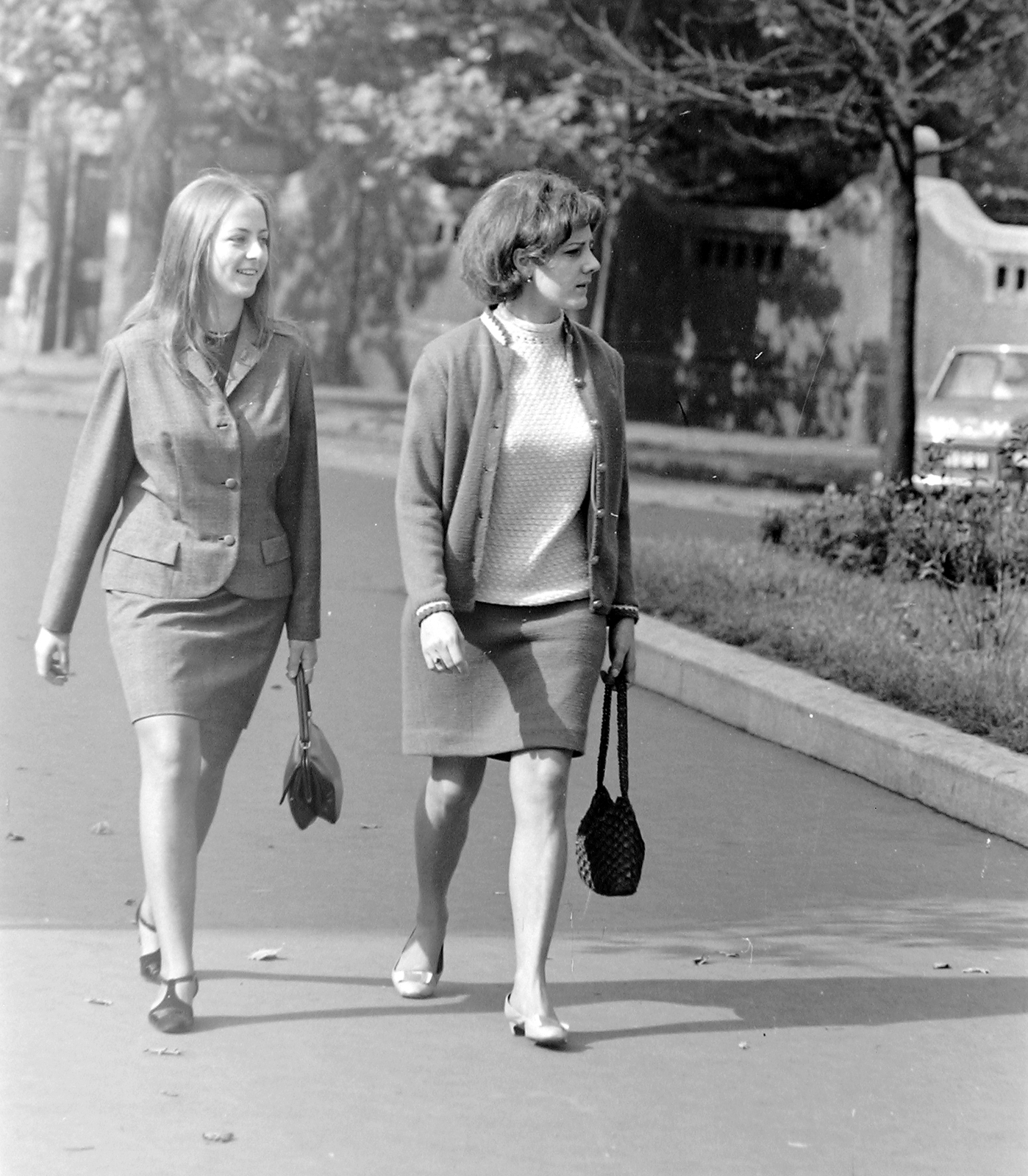
Zsuzsa Takács and Mari Szilágyi stand in two long dresses on a road roller in Szentháromság Square. In the fashion photograph dated to 1970 by Fortepan, the city backdrop and striking staging frame the clothes, but the proportions of their upper sections are most intriguing to a contemporary eye. We have paired it with a Fogas Street scene from 1974, where a patterned shirt and trousers suggest a different solution.
One focus around the face
In the 1970 image, floral embroidery highlights the pale sleeveless dress’s neckline. A large, quiet area follows below it. The eye pauses near the face before travelling down the long dress. The dark dress repeats the principle differently: a broader, colourful upper band meets an open-looking surface extending downwards and more open sleeves.
The outfits relate without sharing every detail. Both combine a long vertical line with colour concentrated around the face. The pale version feels more solid; the dark one gains movement from its open-looking surface and sleeve shape. This is a comparison of forms visible in the photograph; the archive record does not specify the exact fibre composition.
A contemporary adaptation does not require copying an entire occasion dress. An embroidered collar, distinctive neckline or broader border can provide the same focus on a simple top. When pattern is already strong around the face, give it space when choosing a scarf or jewellery. Emphasis becomes legible when a quieter surface surrounds it.
A patterned shirt and a quieter lower half
In the photograph taken four years later, a young woman bends beside a puli dog. Fortepan identifies the location as Fogas Street, seen from Döbrentei Street. The patterned, collared shirt creates a dense surface across sleeves and torso, while the trousers look much more uniform. A black-and-white photograph cannot establish colour relationships, so tonal contrast and pattern density are the useful things to observe.

Archive photograph, Fogas Street, Budapest, 1974. Fortepan / Saly Noémi, 18257; photographer not named. CC BY-SA 3.0. Image source, licence.
The third wearable idea is the division of labour between a patterned top and simpler trousers. The shirt performs most of the visual work, while the trousers hold the outfit together. Today that could mean a small-pattern blouse with plain tailored trousers, though the reverse is also worth trying. The useful idea lies in the proportions of adjacent surfaces rather than a period label.
Movement matters too. A standing fashion photograph can hide what happens when someone sits or bends; the Fogas Street scene shows clothes in relation to the body’s position. When trying on clothes today, sit and reach forward after standing straight at the mirror. This reveals whether the shirt’s length works and whether enough room remains around the trousers’ waist.
A useful proportion works with the garment in movement, as well as when standing.
Borrow an idea, not an entire era
In MúzeumCafé’s independent interview, fashion historian Ildikó Simonovics discusses pairing archival and contemporary photographs and the importance of accurate documentation. The precedent of Street Fashion Budapest, launched in 2010, matters here because it treats everyday clothing as valuable evidence. An arresting image alone does not establish who made a garment, where it was bought or its price.
These two Budapest photographs do not represent every person dressed in the 1970s. One is a staged fashion image with models, the other a street scene, and their differences should remain visible. Euronews’s report on the Kiscelli Museum’s urban fashion-history exhibition likewise presents Budapest’s clothing culture through varied objects and situations. We cite the exhibition as an earlier example, not a programme currently available to visit.
In an autumn wardrobe in Hungary, the principles of these summer images can be carried forward through layers. An open cardigan can frame an ornate neckline, a plain coat can sit over a patterned shirt, and an outer layer of a different length can interrupt a long dress line. These are editorial styling suggestions rather than historical reconstructions.
The neckline’s shape matters when arranging layers. Rounded decoration may call for a different frame from a pointed shirt collar: a coat’s opening can surround the first, while an exposed collar tip can supply a small accent in the second. Try the coat both open and fastened. The same outfit underneath can produce two different impressions without adding another garment.
Next time you get dressed, choose just one of the three details. If the shirt’s pattern takes the lead, let it work; if the neckline does, begin by arranging its frame. Archive photographs start speaking about a personal wardrobe when we bring across one good decision rather than everything at once.
Related reading: Dress-coat braid as an example of composition.