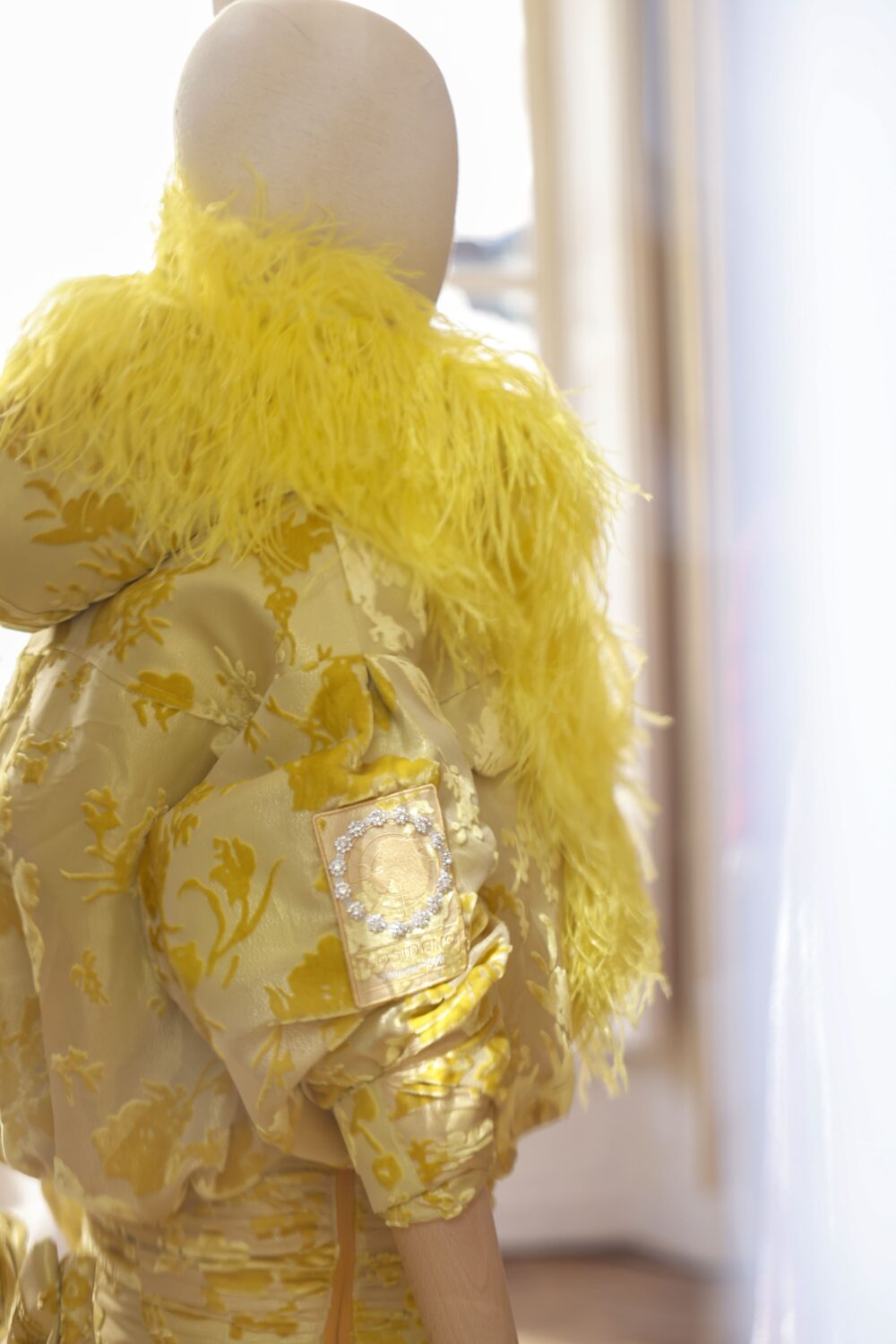
Inside the gilded rooms of Paris's Hôtel Pozzo di Borgo, the down jacket did not appear as a supporting piece. Bosideng staged its fiftieth anniversary show, The Bloom, on 5 October. The decisive change was not only the setting: according to the company, this was its first appearance on the official Paris Fashion Week calendar.
Volume Became the Basis of the Cut
Creative director Pietro Ferragina did not try to hide the mass created by down filling. The collection used O shaped silhouettes, three dimensional moulding and layered surfaces to turn functional outerwear into architectural form. Pantone colours, the alternation of glossy and matte materials and volumes opening around the body suggested that a puffer need not be read only as sportswear or technical equipment.
The official description names the construction of the Shanghai qipao and Song brocade from the Suzhou region as Chinese references, paired with the geometric order of Art Deco. The interest lies in placing the logic of a fitted garment inside a soft, air filled outerwear shape. Down becomes the design material itself.
The strongest claim of The Bloom is that insulating volume is not a compromise to conceal but a silhouette in its own right.
Four lines appeared in the show: Extreme Cold, Outdoor, Business and Puff. This is as important commercially as it is visually. Bosideng is not attempting to redefine the puffer through one runway look; it is linking different situations of use through one design language. Polar protection, urban coats and more formal outerwear entered the same brand story.
A Different International Stake After Fifty Years
Bosideng's own site dates the story from 1976 to 2026 and reports a presence in 72 countries, 1,498 patents and work connected with 46 standards. These are corporate figures and should be read as such. They nevertheless show that Paris was not an emerging label's first experiment but a positioning move by a large Asian outerwear company.
L'Officiel France interpreted the show as a meeting of Chinese aesthetics, performance and fashion. That independent professional view matters because inclusion on a calendar alone does not guarantee lasting influence. Future seasons will reveal whether The Bloom's forms enter the commercial range and whether media attention becomes sustained presence.
The eighteenth century Hôtel Pozzo di Borgo, once Karl Lagerfeld's Paris home, created a historical frame for industrially developed coats. Gilding, crystal chandeliers and modern soft volume produced a strong contrast, but the set must not be confused with the garment. Fill, weight, shell, stitching and intended use still determine a coat's quality.
What Budapest Can Read From It
For Hungarian shoppers, the Paris images are first a lesson in proportion. A large puffer becomes wearable when shoulder, sleeve and hem volumes remain balanced. A short rounded shape gains clarity beside a slimmer lower layer; on a long coat, fastening and freedom of movement may matter more than the photograph. Temperature performance can be judged only from product data, never from a runway image.
The broader lesson for Hungarian professionals is that a technical category reaches fashion's centre not by adding decoration but by turning its structure into a consistent design language. The Bloom demonstrated that shift. The next test is whether a fifty year old brand can translate its Paris flowering into identifiable products and another season of credible professional presence.


